Retired Nurse Reveals a Simple 7-Day Home Reset That Helps Nigerians End Years of Jedi Jedi Pain — Without Surgery, Without Pharmacy Runs, and Without Embarrassment

Adaeze, 34 — Teacher, mother of two, and author of Gut Freedom With Adaeze
If you are reading this right now — stop for a second.
Just stop.
Because I need to ask you something nobody around you has had the courage to ask.
How long have you been carrying this in silence?
How many mornings have you woken up — not to your alarm, not to birdsong outside — but to that quiet, familiar dread sitting heavy in your chest before your feet even touch the floor?
Today go be painful again. I wonder if the blood will show this morning. God, make today be different.
You have already rehearsed the whole thing before you reach the bathroom. You go. You hold your breath. You come out — relieved if it was a small day, deflated if it wasn’t.
Then you wash your hands, put on your smile, and face your day. As if nothing happened.
Your colleagues don’t know. Your spouse may not know. Your closest friend almost certainly doesn’t know either. You have become an expert at hiding this.
You’ve shifted positions in church so many times the person next to you thinks you’re just restless by nature.
You’ve picked restaurants based on where the toilet is — not what is on the menu.
You’ve quietly folded a cloth under you at owambe so you can survive the plastic chairs.
You’ve spent money. Real money. On creams that worked for ten days and then abandoned you. On agbo that tasted like suffering. On a hospital visit that ended with the word “surgery” — and sent you running before they could say anything else.
And still — it comes back. Every single time.
How is this possible? I tried everything. Why does this thing keep returning?
I know that feeling. Not in theory. I know it exactly.
That shame with no name. That quiet exhaustion of managing something you cannot even talk about openly. That ache of watching people around you live normally while you calculate every meal, every sitting position, every public toilet situation.
You are not dirty. You are not weak. You are not cursed.
You are someone who was never told the real truth about why Jedi Jedi keeps coming back — and because nobody told you the truth, every treatment you tried could only ever give you temporary relief.
That changes today.
“Because I am about to share with you the simple 7-day home reset that changed everything for me — and for over 60 Nigerians I have quietly shared it with since.”
Here is something your grandmother understood that the pharmacy counter never will.
She understood that the body is not broken. It is simply out of rhythm. And you do not bring it back to rhythm with chemicals that mask the pain — you bring it back with simple, consistent daily actions that fix what went wrong at the root.
Nigerian grandmothers quietly managed this condition for generations — through the ugu in their soups, the warm water they drank every morning, the simple toilet habits they observed without thinking. Nobody wrote it in a book. Nobody sold it in a bottle. It was passed down, elder to younger, woman to woman, quietly and faithfully.
That knowledge is almost completely lost now. Replaced by creams that give a week of relief and abandon you. Replaced by hospital waiting rooms that end in surgery talk. Replaced by shame that keeps you silent and suffering for years.
My name is Adaeze.
The first thing you should know about me is that I am NOT a doctor, pharmacist, or health professional of any kind. I am a 34-year-old primary school teacher from Enugu who had two children and quietly dealt with Jedi Jedi for almost three years — mostly alone, mostly in shame.
The second thing you should know: I found a way out. Not through surgery. Not through any product you can buy at a pharmacy. Through something so simple that when it was first explained to me, I almost laughed at it.
Let me tell you exactly how it happened.

It started after my second baby.
I had carried him well — people told me it was a straightforward pregnancy. But after delivery, my body changed in a way nobody warned me about.
The constipation came first. Then the straining. Then one morning I looked at the tissue and saw blood. I told myself it was from the delivery. That it would pass.
It did not pass.
Within six weeks, I knew exactly what it was. The swelling. The burning. The way sitting became something I calculated rather than just did. My son was barely two months old and I was already waking up every morning with that quiet dread instead of the joy I had expected to feel.
I said nothing to my husband, Chidi. How do you tell your husband something like this? I was already worried about my body after the pregnancy. This felt like one more thing to hide.
He will think something is wrong with me. Better to manage it quietly and hope it goes away.
So I managed it. Quietly. For three years.
In those three years, I tried everything.
I started with Proctosedyl cream — the one every Nigerian seems to know about. It helped for about ten days. Then the symptoms returned exactly as before, maybe slightly worse.
I ordered a Chinese cream from Instagram. “Permanent cure,” the seller said. “One tube finish the problem.” I used it for three weeks. The problem was very much still alive.
My mother’s friend swore by agbo from a woman in Mushin who “specialised in women’s health.” I drank it faithfully for two weeks. I experienced everything except relief.
A colleague told me to drink more water and avoid pepper. I did that for a week. No improvement. I stopped because it felt like punishment with no reward.
I went to a hospital once. The doctor was kind. He examined me and said the words I had most feared: it might require a small operation. Nothing complicated, he said. Routine.
I left his office, sat in my car in the hospital car park for fifteen minutes, and cried.
Surgery. How will I recover? Who will take care of my children? What will I tell Chidi? How much will this cost us?
I never went back.
My mother noticed something was wrong — she always notices. One evening over the phone she said something I have never forgotten:
“Adaeze, whatever is troubling you, carry it to God. But while you are carrying it to God, do not neglect the practical things. Our grandmothers suffered less not because they were stronger — but because they knew things we have forgotten.”
I didn’t fully understand what she meant. Not until the naming ceremony in Akure.
It was my cousin Ngozi’s daughter’s naming. A big family affair — the kind where the party fills two compounds and spills into the street. I had been dreading it for weeks. The sitting. The plastic chairs. Hours of it.
I arrived early to find a seat with something soft to sit on — my usual calculation. That’s when I ended up at the same table as Mama Eunice.
She was 67 years old and she did not look it. Straight back, clear eyes, the kind of quiet energy that made you want to listen when she spoke. She had been a nurse for thirty years — retired now, living in Akure with her grandchildren.
We started talking about nothing in particular. The children. The food. The way naming ceremonies have changed. I don’t know exactly how the conversation shifted. Maybe it was the way I stood up carefully from my chair when the dancing started. Maybe she had been watching longer than I realised.
But at some point, Mama Eunice leaned over and said, very quietly, without preamble:
“That thing you are managing — how long?”
I froze. She said it so simply, as if asking how long I had been teaching.
I looked at her. She was not embarrassed. Not pitying. Just waiting.
“Three years,” I said. The words came out before I could stop them.
She nodded. Not with surprise. With recognition.
“Most women your age have been managing for one to five years before anybody tells them the real thing,” she said. “The creams cannot cure it. The agbo cannot cure it. They are fighting the symptom. But the symptom is not the problem. The cycle is the problem — and the cycle runs on its own until you break it.”
She explained the Piles Recurrence Cycle — right there at that table, over a plate of jollof rice she barely touched. How constipation creates pressure, how pressure causes swelling, how the treatment reduces swelling temporarily, how constipation returns because nothing in your habits changed, and how the whole thing starts again — usually worse.
“Every cream you have bought,” she said, “every agbo you have swallowed — they all stop at step two. They remove the symptom and send you home. Nobody teaches you how to change the habits that bring the constipation back. So it always comes back. Always.”
She told me about the Nigerian foods already in my kitchen — ugu, okra, pawpaw, tiger nuts, unripe plantain, beans. She explained what each one does inside the body.
She told me about toilet habits — specifically about the phone. About a small footstool. About the five-to-ten-minute rule. About never straining.
She told me about the warm sitz bath — warm water, ten to fifteen minutes, a clean bowl. Something so old and obvious that it felt almost insulting no doctor had specifically told me about it.
She told me about the morning water routine. Two glasses before anything else. Every single morning.
“This is not complicated,” she said. “Your grandmother did all of this without knowing she was ‘managing Jedi Jedi.’ She just lived this way. We complicated it. The real answer has always been in your kitchen and in your daily habits. It always was.”
I listened. And privately, I thought: this is too simple. Surely if it were this simple, a doctor would have told me already.
I started the very next morning. Not because I was convinced. Because I was completely out of things to try.
Two glasses of water before my phone. Akara and pap for breakfast with pawpaw on the side. Ugu in the evening soup. No phone in the bathroom. A small stool — ₦500 from the market — placed in front of the toilet.
Day one, nothing changed. I expected nothing to change.
Day two, nothing either. On Day three I almost stopped.
Another thing that doesn’t work. Another false hope.
I pushed to Day four because I had nothing better to try.
And on Day 6, something shifted.
I went to the bathroom in the morning. I was in and out in four minutes. I did not strain. I did not bleed. I did not sit there calculating the damage afterward. I just — went. Normally. The way I used to go before any of this started.
I stood at the bathroom sink washing my hands and I felt something strange: nothing. No pain. No burning. No bracing for what came next.
I started laughing. Actually laughing — quietly, so Chidi would not hear. Three years of dread in that bathroom and I was laughing because a normal morning visit had become extraordinary.
By week three, Chidi noticed something had changed. He looked at me across the dinner table one evening and said: “Adaeze, you look different. More relaxed. What happened?”
I said I had just been sleeping better.
But I knew.
And by week four — when I could sit through an entire Sunday service on the wooden church pews without shifting once, without a single calculation — I accepted that something real had changed. Not temporarily. Actually changed.
I went back to the naming ceremony WhatsApp group and quietly shared what I had done with two women who had confided in me over the months since that day.
Mrs. Folake, 44, a civil servant from Lagos Island, had been dealing with it for six years. By Day 8 she sent me a voice note that was mostly crying. “Adaeze. I am going to the toilet like a normal human being. Six years. SIX. I am going to the toilet like a normal human being.”
Chiamaka, 29, a nursing mother in Asaba, suffered postpartum and was too embarrassed to mention it at her postnatal appointments. Within ten days she messaged: “That warm sitz bath alone. Adaeze. That alone. Why did nobody tell us this?”
Hajiya Binta, a trader in Kano in her early fifties, changed things gradually over two weeks. After three weeks: “My morning has changed completely. I cannot explain it. I just know it has changed.”
I began to understand something important.
The knowledge Mama Eunice shared with me at that naming ceremony — this simple, practical, Nigerian-specific understanding of the recurrence cycle and how to break it — it was not reaching the people who needed it most. It existed in the minds of retired nurses and village elders. It was not available in a form that a 31-year-old teacher in Ibadan, a bus driver in Oshodi, or a nursing mother in Asaba could access privately — at 3am, alone, quietly desperate.
So I decided to change that.
I started receiving messages. People who heard from Folake. People who found this blog at 3am through Google.
“Can you send me what you did, step by step?”
“Do you have a guide? Anything I can follow properly?”
I was answering individually — twenty, thirty, forty people — typing the same things each time. I realised I needed to put everything in one place. So I did.
I put everything — the full explanation of the recurrence cycle, the Nigerian food protocol, the exact toilet habits, the sitz bath method, the morning and evening routine, the 7-day reset plan, the myths keeping Nigerians suffering, and the FAQ people are too embarrassed to ask anywhere else — into one complete, simple guide.
Everything Mama Eunice shared with me. Everything I tested on myself. Everything that worked for Folake, Chiamaka, Binta, and over 60 others since.
One guide you can read tonight and start using tomorrow morning.
Introducing…
The Jedi Jedi Freedom Code
How Nigerians Are Quietly Ending Years of Piles Pain in 7 Days Using Only Local Foods, Simple Habits, and Home Methods
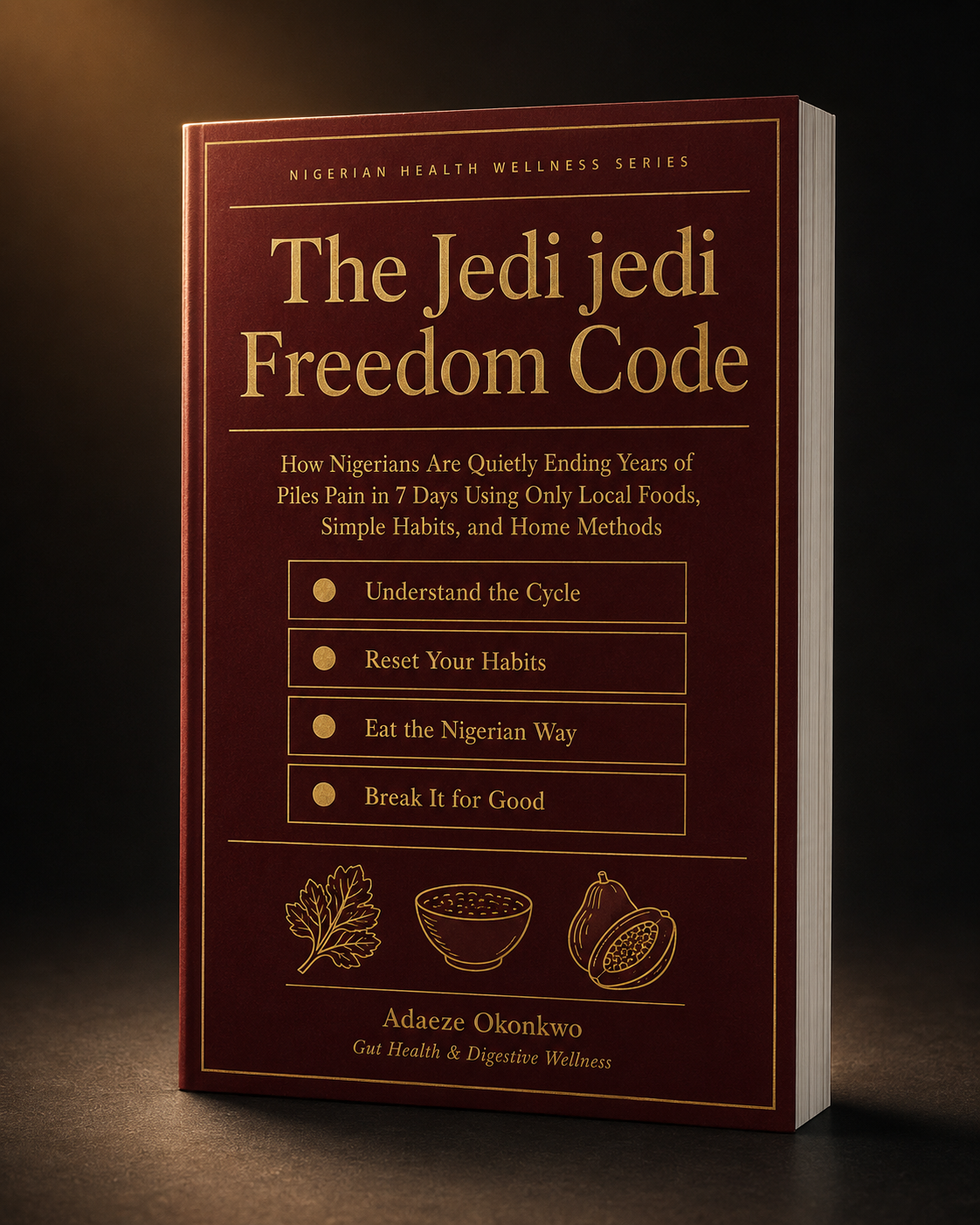
📖 Inside This Guide, You Will Discover:
- The Piles Recurrence Cycle — in plain language — why every cream, agbo, and pharmacy run has failed you, and the exact point this guide breaks the cycle permanently — Pg. 7
- The Nigerian Food Protocol — a complete list of local market foods (ugu, okra, tiger nuts, unripe plantain, pawpaw, beans, ewedu) that soften stool naturally, lubricate the passage, and reduce the daily straining that keeps causing flare-ups — Pg. 10–11
- 5 Toilet Habits That Change Everything From Day 1 — including the ₦500 footstool method, the phone-free bathroom rule, and the one mistake almost every Nigerian makes every morning that silently worsens the condition — Pg. 14–15
- The Safe Home Comfort Method for Flare-Up Days — how to prepare the warm sitz bath in under 15 minutes, the Vaseline technique, and the rest position that immediately takes pressure off even on your worst days — Pg. 18
- The 7-Day Nigerian Lifestyle Reset Plan — one small doable action per day, built for real Nigerian daily life — not a Western diet plan, not a supplement schedule — Pg. 24–25
- 8 Myths Nigerians Believe About Jedi Jedi — debunked — including the truth about whether it is spiritual, whether surgery is always required, and why stopping bleeding does NOT mean it is healed — Pg. 22–23
- The Private FAQ — honest answers to the questions people are too embarrassed to ask anyone — including whether Jedi Jedi affects pregnancy, whether creams actually cure anything, and how to talk to a doctor without wanting to disappear — Pg. 29–30
And the best part? You do not need to buy any supplement, visit any pharmacy, or overhaul your entire diet overnight. It is the same simple daily reset that worked for me — and has now quietly worked for over 60 people. Starting with food already in your kitchen, and habits that cost absolutely nothing.
Real People. Real Results. Real Words.
📝 Share Your Experience
📝 Just So You Know… Putting This Guide Together Cost Me Over ₦87,000
- Professional medical writer and editor to verify every claim — ₦32,000
- Research and consultation with retired healthcare professionals including Mama Eunice — ₦18,000
- Graphic designer for guide layout, charts, and trackers — ₦14,500
- Testing phase — distributing to 60+ volunteer readers for real feedback — ₦12,000
- Website setup, hosting, and digital delivery infrastructure — ₦10,500
Not ₦45,000. Not ₦25,000. Not ₦15,000.
A fair price for this complete bundle would be
But I want this in the hands of every Nigerian who needs it.
🎁 WAIT — You Also Get These FREE Bonuses!
If you are among the first 40 buyers paying right now, you receive these two bonuses alongside your main guide. TODAY ONLY.
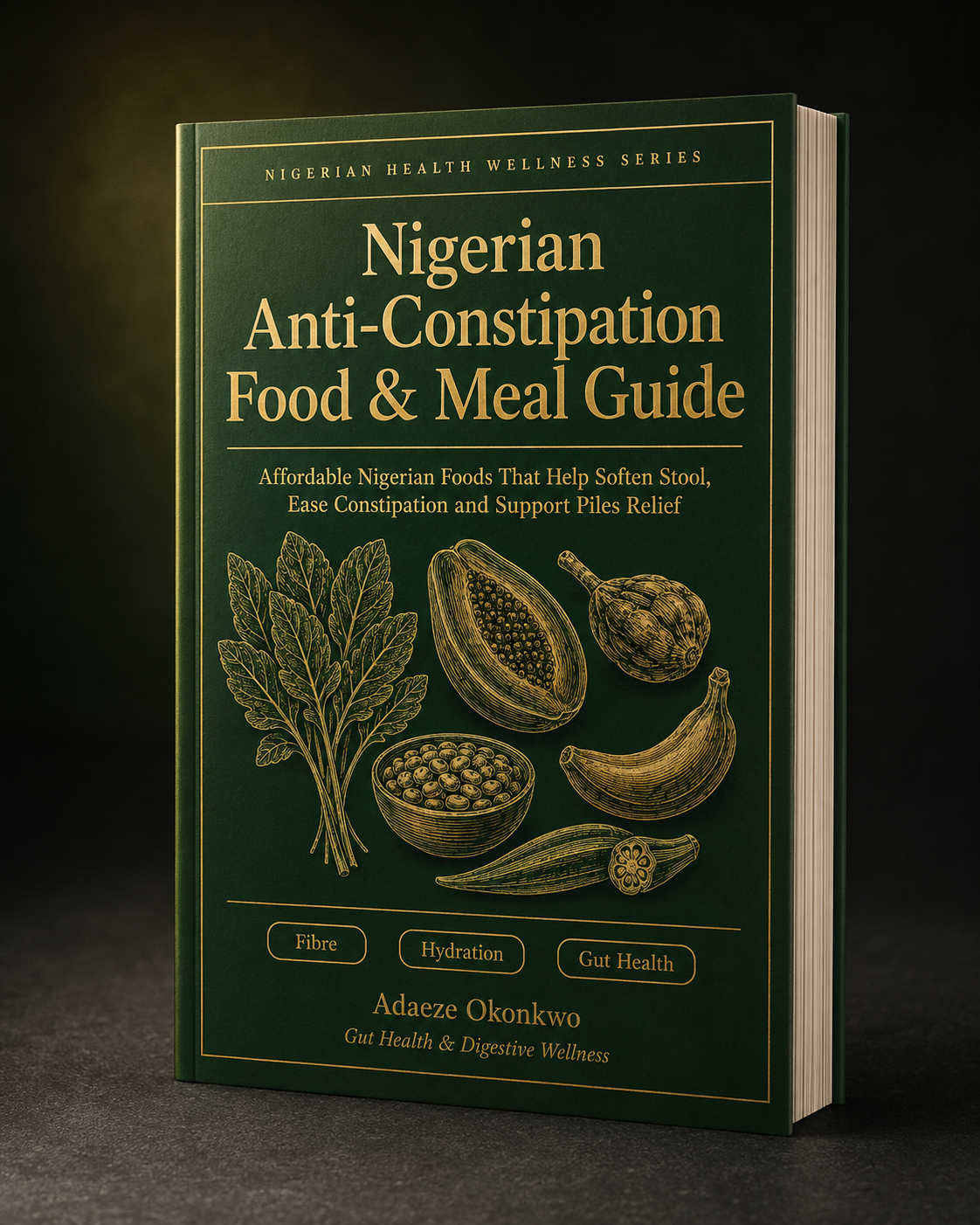
Nigerian Anti-Constipation Food & Meal Guide
The complete 27-page companion with Nigeria’s best anti-constipation foods, a full 7-Day Nigerian meal plan, budget eating under ₦1,500/day, hydration habits, healthy snack swaps, and a weekly market shopping checklist. Worth ₦5,000 — yours free today.
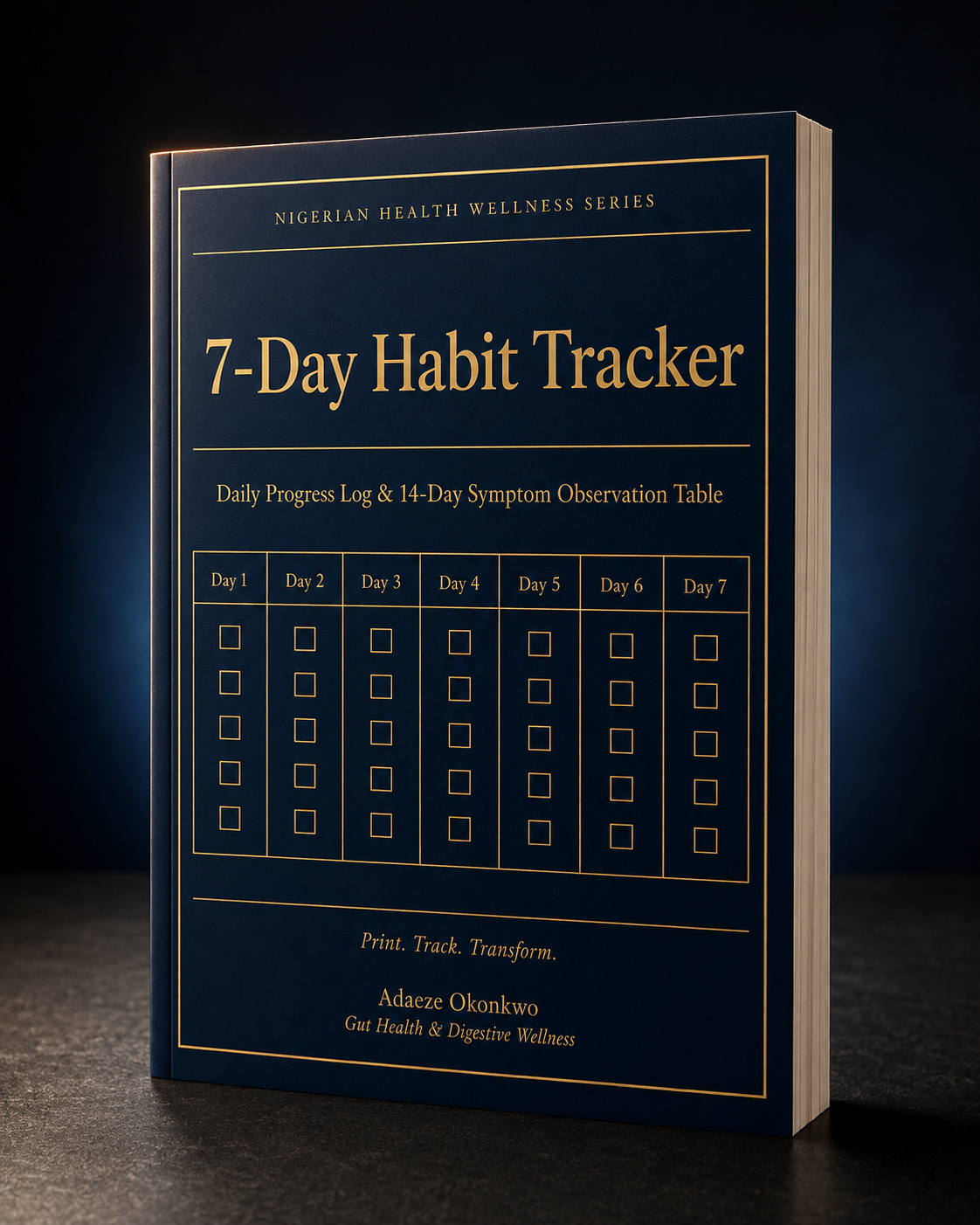
Printable 7-Day Habit Tracker + 14-Day Symptom Observation Table
Print and stick on your fridge or bathroom wall. Track daily water, fibre foods, toilet habits, and symptom progress over two weeks. Watching your own numbers improve is one of the most powerful motivators. Worth ₦2,000 — yours free today.
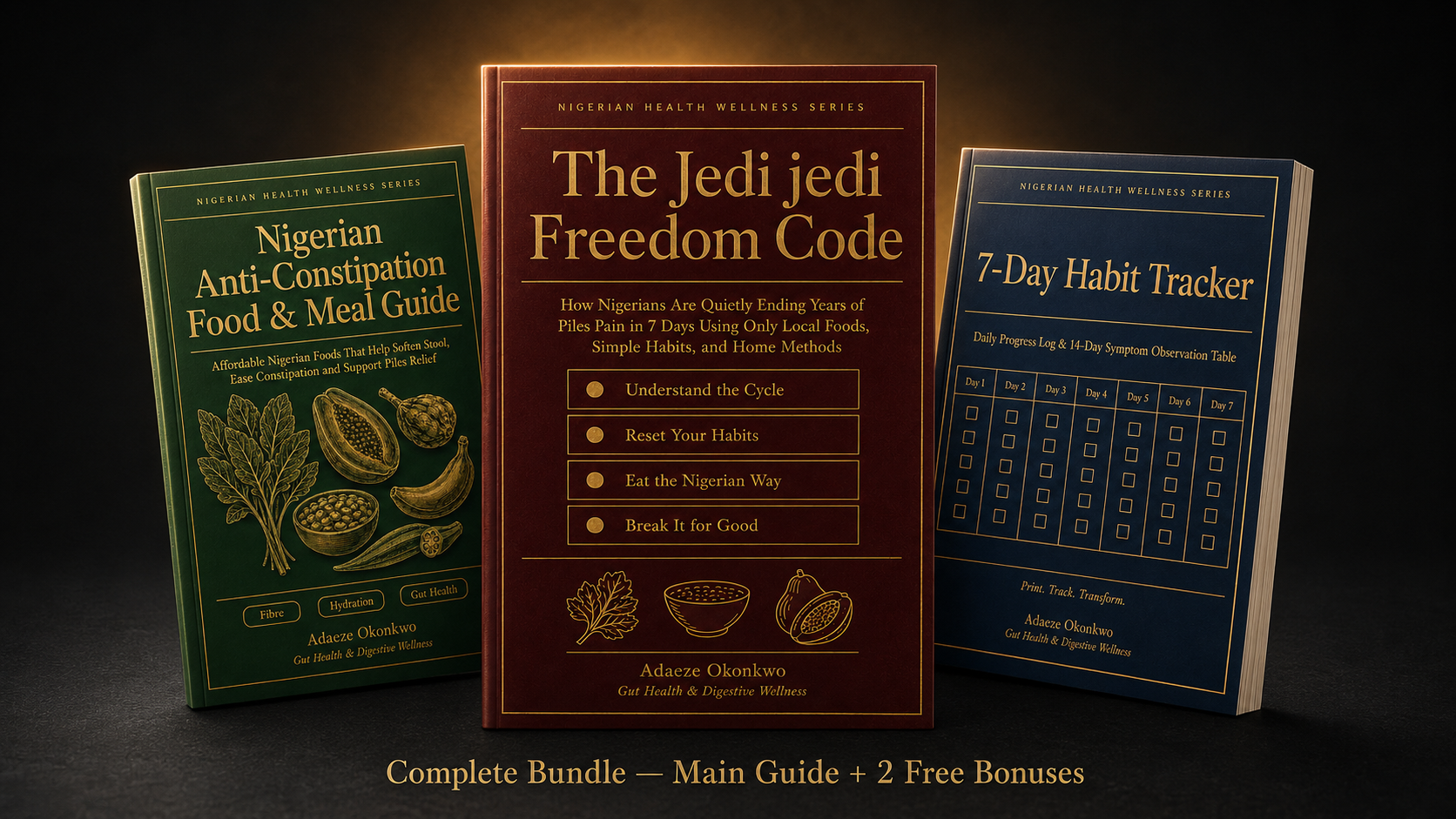
Everything you get today — Main Guide + 2 Free Bonuses
👀 Others Are Getting Access Right Now…
You are not the only one on this page right now. Someone else is reading this at this exact moment and deciding whether to act.
The question is not whether this guide will help you. The question is whether you will let it.
My Bold, Risk-Free Promise to You
Still unsure? You have every right to be. You have spent money before that did not work. I understand completely.
Which is why I am making you this promise: use the guide for 30 days, follow the simple steps inside, and if you do not see a meaningful change in your daily experience — I will refund every naira you paid. No argument. No questions. Full refund.
I can make that promise because I have seen what this guide does for people. You have nothing to lose. Your only real risk right now is continuing to suffer the way you have been suffering.
30-Day Full Money-Back Guarantee. No Questions Asked.
More From People Who Started the Reset
You have read this far. That means something — it means there is a part of you that knows, quietly and certainly, that what you have been doing has not been working.
So here are two honest choices.
And in two weeks — wake up to a morning that feels different. Normal. Free.
Maybe God brought you to this page for a reason. The morning will be the same tomorrow if nothing changes today.
This guide is for educational purposes only. For severe or persistent symptoms, please consult a qualified healthcare professional. Results vary by individual.